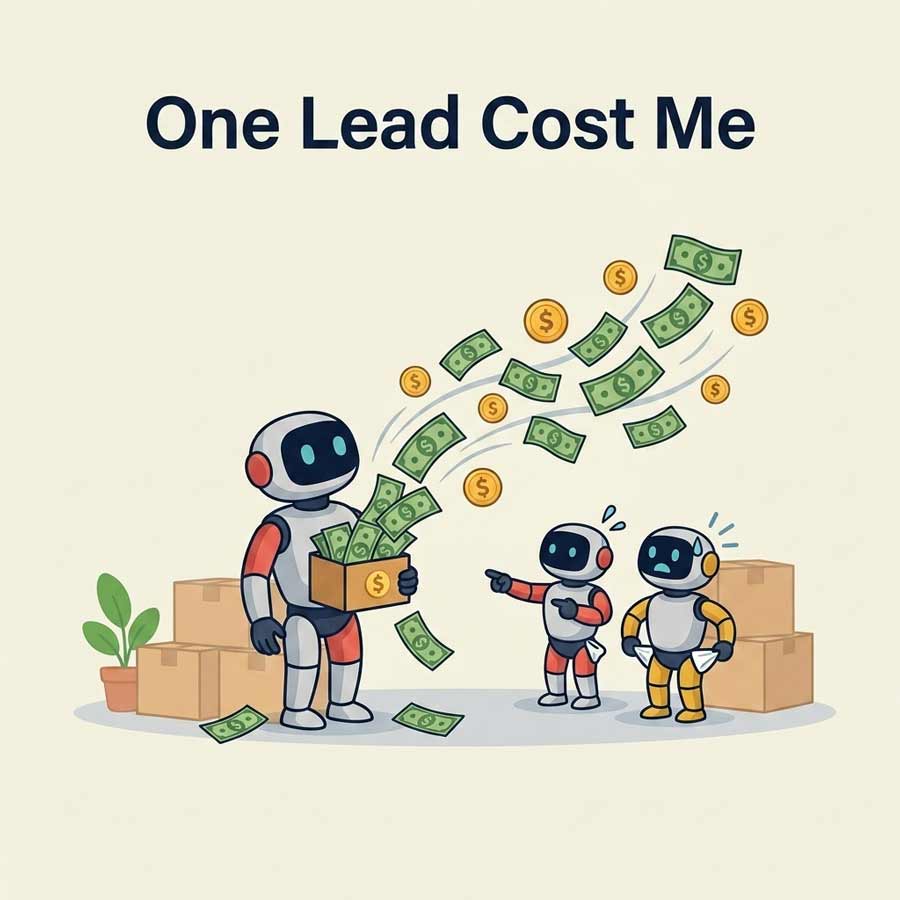
42 tasks
What a single lead cost me on Zapier, because it fanned out to 40 advertisers one at a time. At 40 to 60 leads a month, that's 1,700 to 2,500 tasks for a workflow doing one simple job.
The workflow was simple. The bill wasn't.
Here's the whole thing. A lead comes in from a form, I store it, I pull the fields apart, I drop them into an HTML template, and then I email it out to my list of advertisers in the service trades.
That's it. Four ideas, and a person could describe the whole thing in one breath.
My advertiser list had 40 names on it.
Why that number ruined me
On Zapier a task is one action step that runs. The trigger is free and a filter is free, but almost everything else costs you.
So count my flow. Store the lead, that's one. Parse it, mostly free. Then send to 40 advertisers, one at a time, and a loop bills you once per pass.
Call it 42 tasks. For one lead.
I was getting 40 to 60 leads a month, which comes to 1,700 to 2,500 tasks a month for a workflow that does one simple job.
Now put that against my actual plan. Zapier prices Professional on a sliding scale, so the more tasks you need the higher the tier climbs, even though the plan name never changes. I started at $19 a month, which covers a modest task allowance, and at 42 tasks per lead even 20 leads in a month was enough to push me past it.
I never upgraded to a different plan. I just needed more tasks, so Zapier moved me up a tier automatically. $39 a month, same plan, same features, for doing the exact same job.
Rates checked August 2026 against zapier.com/pricing. Zapier's task tiers are a slider rather than fixed steps, so your exact numbers will differ. Check the current page before you rely on any of this.
My bill went up when business went well
The dollar figure isn't the part that bothers me now. This is: every advertiser I signed made every future lead cost more.
Advertiser number 41 wasn't a one-time fee. It added a task to every single lead, forever. Same with 42, same with 50.
Think about what that means. Signing an advertiser is the best news I get all week, it's the whole business, and it quietly raised my costs on every lead that would ever come in after it.
Leads went up. Advertisers went up. The bill went up twice.
I wasn't paying for software. I was paying a tax on growth.
What the money was actually buying
Here's what I learned when I rebuilt it, and it's the part I didn't expect.
I always thought I was paying Zapier to run steps. I wasn't. I was paying it to make five decisions for me, and I never once thought about any of them.
- Where the thing lives. My workflow had to run somewhere, and Zapier was that somewhere. I never picked it and I never priced it.
- What starts it. A lead comes in and something has to notice. Zapier handled that. I didn't know how, and I didn't need to.
- What sends the email. Forty emails per lead have to leave from somewhere real. That's a whole product category, and I had never looked at it.
- How the email looks. Outlook isn't Gmail, and Gmail on a phone isn't Gmail on a laptop. My template had to survive all of it.
- What counts as a real lead. Duplicates, junk, bots, somebody typing "test" into my form at 2am.
Five decisions. Every month, for years, I paid to not make them.
That's a fair trade when you're starting out. It stops being fair when the price rises every time you win.
The junk lead problem nobody warns you about
This one still stings. A spam lead cost me the same as a real one, all 42 tasks, so I paid full price to blast garbage to 40 advertisers who trusted me to send them work.
The money was bad and the product was worse. My advertisers don't care about my task bill. They care that what lands in their inbox is worth opening.
When I rebuilt it, filtering happened before the fan-out, and it costs nothing now. A junk lead dies in one step and never reaches anybody.
That change alone made the list better, and it had nothing to do with saving money.
It took 18 hours, not 8
I want to be straight about this, because I guessed low. I figured 8 to 12 hours. It took 18.
Those 18 hours weren't spent fixing a broken build. They were spent finding out that my workflow was never one workflow.
Zapier let me believe "send leads to advertisers" was a single thing. It isn't. Once I owned it, it turned into six:
- Keeping the advertiser list current, as names get added and dropped
- Checking that a lead is real before anybody hears about it
- Writing an email that reads like a person wrote it, not a mail merge
- Sending it
- Handling the send when it doesn't go through
- Keeping a record of what went out, to whom, and when
Each one is small and none of them are hard, but I had never thought about a single one of them, because I'd been renting the answers for years without knowing it.
That's the honest reason for the 18 hours. Not bugs. Discovery.
Zapier never stopped costing me time either
Here's the part I didn't add up until I switched. The 20 hours I spent building the Zapier version was never the whole bill, because it kept costing me time long after it was live.
When I ran out of tasks partway through a month I had to stop and decide: raise the limit and pay more, or let things queue and hope nobody noticed the delay. That decision came back again and again, and each time it cost me something.
When a Zap needed a change I was back inside their editor, tracing through steps I hadn't looked at in months, trying to remember which one did what. Small changes took real time to make safely.
Add it up honestly and it's well past 20 hours by now. Thirty-plus, and still climbing, because Zapier maintenance never really ends. You just stop noticing you're doing it.
My own build is the opposite. There's still some upkeep, since nothing runs itself forever, but when something needs a look I know exactly where to go because I wrote every piece of it, and AI helps me trace the problem and fix it fast. There's no chain of steps to guess through and no waiting on my own memory of how I built it.
So the real comparison was never 20 hours against 18. It's a cost that keeps growing, in both dollars and hours, against a build with a little upkeep that gets easier to handle with help.
The failure that actually taught me something
Here's the part I'd want to know if I were you. Sometimes the send just didn't happen.
Not an error on my screen. Not an alert. The script would hit its time limit part way through, or the trigger wouldn't fire at all, or my two pieces would hand data to each other in the wrong shape and quietly do nothing.
Google gives a script six minutes to finish. That sounds like plenty, until you remember I'm sending to 40 people one at a time, after checking the lead and writing the email. Two leads landing close together and that window gets tight.
Silence is the dangerous part. A loud failure is easy, because you see it and you fix it. A quiet one means my advertisers are sitting there getting nothing, and I don't find out until somebody asks why it's been slow.
So I had to build the boring stuff. A way to know a send finished, a way to try again when it didn't, and a record of what actually went out.
Zapier did all of that for me and I never once thought about it. That was genuinely part of what I was paying for, and I'd rather say so than pretend otherwise.
The difference now is that I know it exists, and it's mine.
What "free" actually means here
I want to be careful with that word, because it gets thrown around a lot.
The logic runs on Cloudflare Workers, on their free tier. The emails go out through a script attached to a Google Sheet, on a Workspace account I already pay for. So it didn't add a new line to my bill, and that's all I mean by free. It isn't magic. Both pieces just sit inside limits I was nowhere near.
And I checked the limits, because "free until it breaks" is not a plan.
Google counts email recipients rather than emails. Each lead goes to 40 advertisers, so each lead costs me 40 recipients, and a Workspace account allows 1,500 recipients a day. That's about 37 leads in a single day before anything stops.
I get 40 to 60 in a month.
That headroom is the part I like most. My old setup got more expensive with every lead, and this one doesn't flinch until I'm running roughly twenty times my current volume. If I ever get there, that's a very good problem and I'll happily pay to solve it.
One warning if you copy this idea. On a personal Gmail account the limit is 100 recipients a day, not 1,500, so with a 40-name list that's two leads a day before the script throws an error and quits. It doesn't warn you. It doesn't retry. Your advertisers just get nothing.
Check which kind of account you're on before you trust it with anything that matters.
The math, plainly
| Before | After | |
|---|---|---|
| Cost per month | $39 | No new spend |
| Cost per lead | About 42 tasks | Nothing |
| Cost of a new advertiser | Higher bill on every future lead | Nothing |
| Cost of a junk lead | Full price, 42 tasks | Nothing |
| Room to grow | Next task tier up | About 37 leads a day |
| Time to build | About 20 hours | About 18 hours |
| Time to maintain | Ongoing, 30-plus hours and climbing | A little, and AI makes it quick to trace and fix |
| Who fixes it at 9pm | Zapier | Me |
Here's the honest math, at $30 an hour.
Zapier cost me 30-plus hours by the time I left. Call it $900 in my own time, and that's before a single dollar of the monthly bill. My own build cost 18 hours, or $540, and what maintenance is left is small, because when something needs a look AI helps me trace it and fix it fast instead of me hunting through it alone.
That's already $360 less in time alone, before I count a single month of the $39 I no longer pay. The switch had paid for itself before the first invoice I didn't get.
Would I tell you to do this?
Only if your workflow has the shape mine did.
Fan-out is the tell. If one thing coming in causes many things to go out, per-task pricing will punish you, and it gets worse as you grow. Leads to a list. Orders to suppliers. Bookings to a team.
If your automations are one-to-one, where a lead comes in and a row gets added, stay where you are. The price is fine and your time is worth more than the savings.
But if you're paying more every quarter to do the exact same job, look at your busiest workflow and count the steps, then multiply it out.
I think you'll find the number is bigger than you expected. Mine was.
The wider version of this argument, and what finally made me leave, is in why I left Zapier and Make.
Common questions
Why did one lead cost 42 tasks?
Because it went to 40 advertisers. Each one is its own send, and a loop bills once per pass, so add the step that stores the lead and you land near 42. The workflow was simple. The fan-out wasn't.
Could you not have batched the emails?
I tried. Batching saves tasks but costs you the personal touch, and my advertisers want their own clean email. I was reshaping my product to fit a price list, and that was the moment I knew I had a problem.
Is 40 advertisers a lot?
Not for the business. It's a lot for per-task pricing, and that's the point. The number that made my business work was the same number that made my bill hurt.
What broke after you switched?
Sends that quietly didn't happen. The script would hit its time limit, or the trigger wouldn't fire, and nothing would tell me. That's worse than a loud error. I had to build my own way to confirm a send finished and to try again when it didn't, which Zapier had been doing for me all along.
Do I need to be technical to do this?
Less than you'd think, but more than zero. The building was the easy part. Choosing the pieces was the work.
Does your homepage pass the three second test?
A visitor decides in about three seconds whether your site is for them. Put your address in and I will send you what a stranger actually takes from it, and the specific things to fix.
Scan my site free →Does one lead fan out to a whole list?
That shape is where per-task pricing hurts most. I build custom workflow apps for small businesses across Northeast Florida, so growth stops raising the bill.

Mike is the founder of gravityGone, where he helps small businesses in Northeast Florida grow through Web Development, SEO, and Marketing Automation.