The promise nobody checks
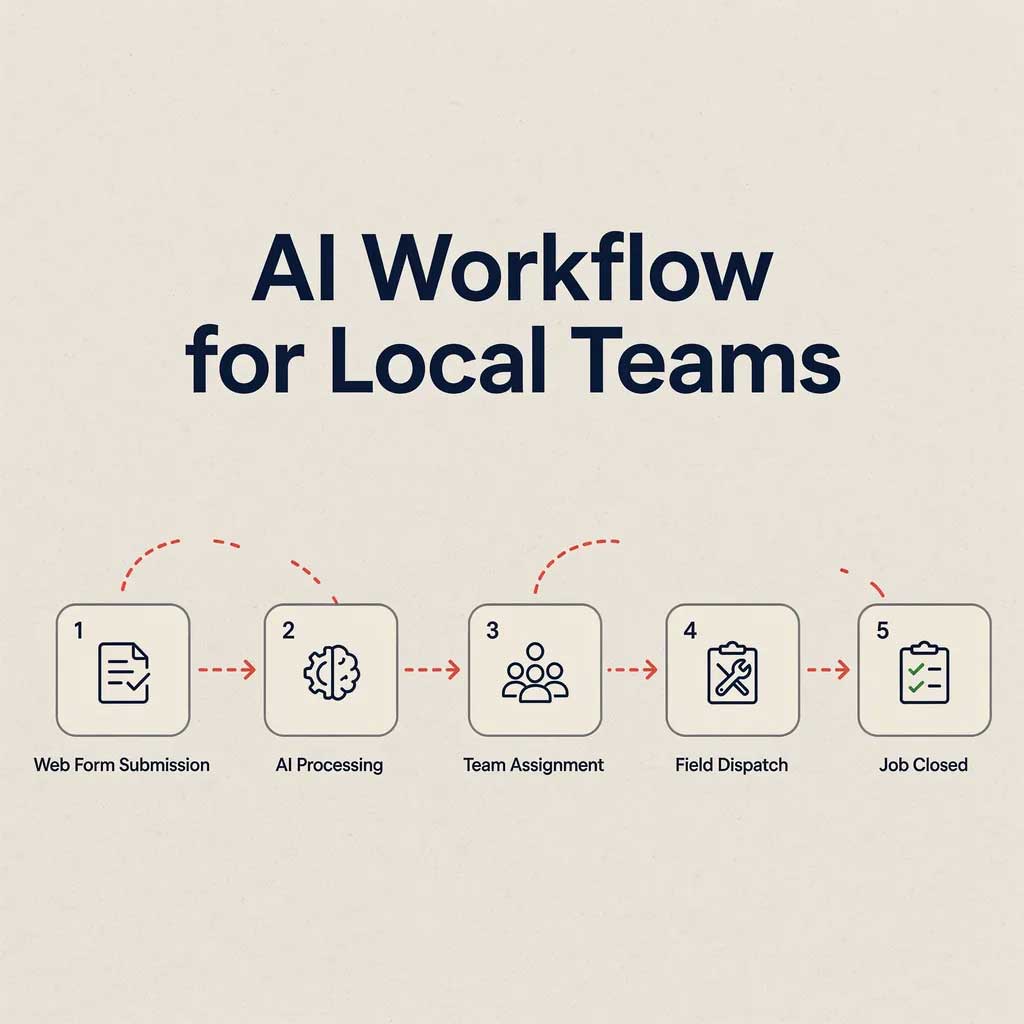
Blueprints like this one usually lay out five neat stages. Capture the lead. Qualify it. Follow up. Book the job. Track completion. Each stage hands cleanly to the next. At the end you get a closed job you can trace back to the form that started it.
The stages are real enough. I have written about each of them. The problem is the last part, the tracing.
Ask most service business owners which closed jobs came from website forms, and they can guess. They cannot show you. The form software knows about submissions. The CRM knows about contacts. The scheduling tool knows about appointments. The invoicing system knows about paid work. In most small shops, none of those four systems share an identifier that would let you follow one customer across all of them.
So the line from form to closed job is not really a line. It is four separate records that a human connects by recognizing a name.
The honest starting point
You probably cannot prove which closed jobs came from your website. Most businesses cannot.
Where the trail goes cold
The breaks are predictable, and knowing where they are tells you which ones are worth fixing.
- The customer switches channels. They fill out the form, then call before anyone replies. Your phone system has no idea that caller is the same person who submitted a form four minutes ago.
- Someone creates a second record. A tech takes details over the phone and types a new contact. Now one customer exists twice, and the closed job attaches to the copy without the form on it.
- The job closes weeks later. A roof quote in March becomes work in May. By then nobody is thinking about where the lead came from, and nothing carries that information forward automatically.
- The work gets invoiced somewhere else. Accounting software usually has no link back to the CRM record. That is where "closed" actually gets recorded, and it is the system least likely to be connected.
- The referral looks like a form. Somebody hears about you from a neighbor, searches your name, and fills out the form. Your data calls that a website lead. It was word of mouth.
That last one is worth sitting with. Even a perfectly connected system will get some jobs wrong. The form captured the moment of contact, not the reason for it.
Why that gap gets exploited
Here is why this is worth caring about rather than shrugging at.
Articles about automation routinely quote returns. You will see claims that businesses see 300 to 500% ROI in the first year. Or that a workflow saves 10 to 15 hours a week. Or that setup pays for itself in three to six months. Those numbers show up without sources, stated with confidence.
They survive because almost nobody can check them. If you cannot trace your own closed jobs back to their source, you cannot check a claim about what automation did for your revenue. The number sounds plausible, you cannot test it, so it stands.
The same goes for cost figures. Setup ranges and monthly platform costs get quoted as if they were stable. Platform pricing changes constantly and scales with your volume. The only number that means anything is the one on the vendor's pricing page today, multiplied by your real usage.
Treat any specific return figure in this category as marketing until someone shows you the method behind it. Including, reasonably, anything you read here.
What you can actually measure
Attribution across the whole journey is hard. Plenty of useful things are not.
- Form submissions. Straightforward, and you already have it.
- Time to first human response. The single most useful number in this whole subject, and easy to capture. Timestamp the submission, timestamp the first reply.
- Submissions that got no response at all. Usually ugly, always instructive, and it needs no cross-system tracing.
- Submissions that became a conversation. One system away from the form. Reachable for most businesses.
- Conversations that became a booked appointment. Two systems away, and the point where this starts requiring real setup.
Notice these get harder the further down you go. That is the actual shape of the problem. It is also a good reason to start measuring at the top, rather than building full-funnel reporting on day one.
Phone calls need their own handling, since most default analytics never record them. That measurement work is covered in advanced GA4 tracking for local businesses.
Closing the gaps worth closing
Two of the breaks above are worth engineering around. The rest usually are not.
Worth fixing: the duplicate record. Match on email or phone before creating any new contact. Normalize the format first, so a number stored two ways still matches itself. This one fix collects several problems at once, and it is the foundation for anything else you try to measure. The detail is in reducing manual data entry.
Worth fixing: carrying the source forward. When a lead becomes a job, the job record should keep where the lead came from. One field, copied at the handoff. Without it, every downstream question about source becomes guesswork.
Usually not worth it: full cross-system attribution. Connecting your invoicing system back to your form software so revenue traces to a submission is real engineering. For a business closing a few dozen jobs a month, the effort costs more than the insight returns. Ask the customer instead. "How did you hear about us" on the intake form is imperfect, and it is far cheaper than a data pipeline.
Usually not worth it: multi-touch modeling. Splitting credit across every interaction before a sale is a real discipline at scale. At local service volumes there is not enough data for the model to say anything trustworthy.
Guardrails and failure recovery
- Alert on silence. Watch for missing activity, not just errors. Zero form submissions recorded during a normal week usually means the form broke, not that demand vanished.
- Test the form after every site change. This is the most common silent failure in the whole chain. A theme update or a plugin change disconnects the form, and nothing announces it.
- Never let a submission exist in only one place. Send it to a monitored inbox in parallel with whatever automation does. If the integration fails, the lead still reaches a person.
- Deduplicate before you create. Search first, update if found, create only if not. Most connectors support this and most setups skip it.
- Keep the raw submission. Whatever the customer typed, in their words, stored somewhere it will not be overwritten by a tidy category.
- Re-check your numbers quarterly. Not the dashboard. Pull ten closed jobs and try to trace each one back by hand. That tells you how much your reporting actually knows.
The failure patterns that cost the most are collected in top AI automation bottlenecks in service businesses.
Where to start
Start at the top of the funnel, where measurement is cheap and the payoff is largest. Every submission lands somewhere durable, gets an instant acknowledgment, and gets a timestamped first response from a person. Track those three things and nothing else for a month.
That gives you a real baseline instead of an estimated one. It also tends to surface the actual problem, which is often not a technology gap at all. Plenty of businesses discover their issue is that nobody owns the inbox after 5pm.
Add downstream tracking only when the top is working and you have a specific question the current data cannot answer. Building full-funnel reporting first is how these projects produce dashboards nobody trusts and nobody opens.
The build order for the workflow itself is in creating effective automation workflows. The lead-capture piece is in automating lead capture and instant follow-up, and routing is in AI lead qualification workflows.
Common questions
Can I actually trace a closed job back to a website form?
Probably not today, and most businesses can't. The form software, CRM, scheduling tool, and invoicing system usually don't share an identifier, so the line is really four separate records that a human connects by recognizing a name. That's the honest starting point, and it's fixable in pieces.
What should I measure first?
Start at the top, where measurement is cheap. Track form submissions, time to first human response, and submissions that got no response at all. Do that for a month and nothing else. It gives you a real baseline, and it usually surfaces the actual problem, like nobody owning the inbox after 5pm.
Should I believe the ROI numbers quoted for automation?
No, not without a method behind them. Claims like 300 to 500% ROI survive because almost nobody can trace their own closed jobs back to the source, so nobody can check them. Treat any specific return figure as marketing until someone shows you how it was measured, including anything I write.
Which attribution gaps are worth fixing?
Two of them. Match on email or phone before creating any new contact, so one customer never exists twice, and carry the lead source forward onto the job record at the handoff. Full cross-system attribution and multi-touch modeling usually aren't worth it at local volumes. Ask how they heard about you instead.
Does your homepage pass the three second test?
A visitor decides in about three seconds whether your site is for them. Put your address in and I will send you what a stranger actually takes from it, and the specific things to fix.
Scan my site free →Not sure which jobs your website actually produced?
I set up lead capture and tracking for service businesses across Northeast Florida. I measure what can honestly be measured, instead of building dashboards nobody trusts.

Mike is the founder of gravityGone, where he helps small businesses in Northeast Florida grow through Web Development, SEO, and Marketing Automation.