The sequence is usually the wrong shape
Nearly every guide to lead nurture recommends five to seven touchpoints spread over two to three weeks. That shape comes from B2B software marketing, where a buyer researches for months, brings in a committee, and genuinely benefits from being educated over time.
Now think about how someone actually hires a roofer. They notice a leak. They call three companies. They hire whoever responds well and can come out soonest. The whole decision is over in a day or two, sometimes an hour.
Running a three-week educational drip at that person is not just weak. It is a little insulting. By touchpoint four, they either hired someone else two weeks ago, or they are annoyed you are still emailing about a problem they already solved.
For most local service businesses, the honest sequence is short, front-loaded, then it stops. Nearly all the value sits in the first hour. The rest of this guide covers how to build that, plus the narrow cases where a longer sequence really does make sense.
The shape that fits
Most of the value is in the first hour, not the third week. Front-load it and know when to stop.
Why the channel stats are meaningless
You will see one claim in almost every article on this subject: text messages get around 90% open rates, against roughly 20% for email. It sounds like a clean argument for SMS. Both halves of it are unmeasurable.
SMS has no read receipt. The protocol has no way to report back whether a marketing message was read. What your SMS platform calls an "open rate" is a delivery confirmation, or a guess built from response behavior, dressed up as a measurement. Nobody can tell you what share of your texts were actually read. Not even your vendor.
Email open tracking is broken too. Open rates are measured with an invisible tracking pixel, and since 2021, Apple's Mail Privacy Protection has defeated that. In Apple's own words, it "prevents senders from seeing if you've opened the email message they sent you." It works by pre-fetching message content, which fires the pixel whether a human ever looked or not. Given how many of your customers read mail on an iPhone, your real email open rate is inflated by an unknown amount.
So that famous comparison sets an unverified guess against a metric that has been broken for years. Neither number should drive a decision about your business. Pick channels on the merits below instead.
Choosing a channel for the right reason
The real differences between channels are practical, not statistical.
- SMS is immediate and intrusive. It lands on a lock screen. That is exactly right for "we got your request, can we come Tuesday at 9," and exactly wrong for anything that can wait. Intrusiveness is a budget you spend down over time.
- SMS is regulated. Automated texting to US mobiles needs carrier registration through A2P 10DLC. The FCC's rules also split commercial texts, which need written consent, from informational ones, which do not. I cover this in detail in missed calls and web leads. It is the most-skipped part of any SMS build.
- Email carries detail well. Quotes, scope, photos, financing options, licenses and insurance certificates. Things people want to read carefully, or forward to a spouse.
- A phone call still converts best for high-value work. The automation's job is to get the right person to make that call at the right time, not to replace it.
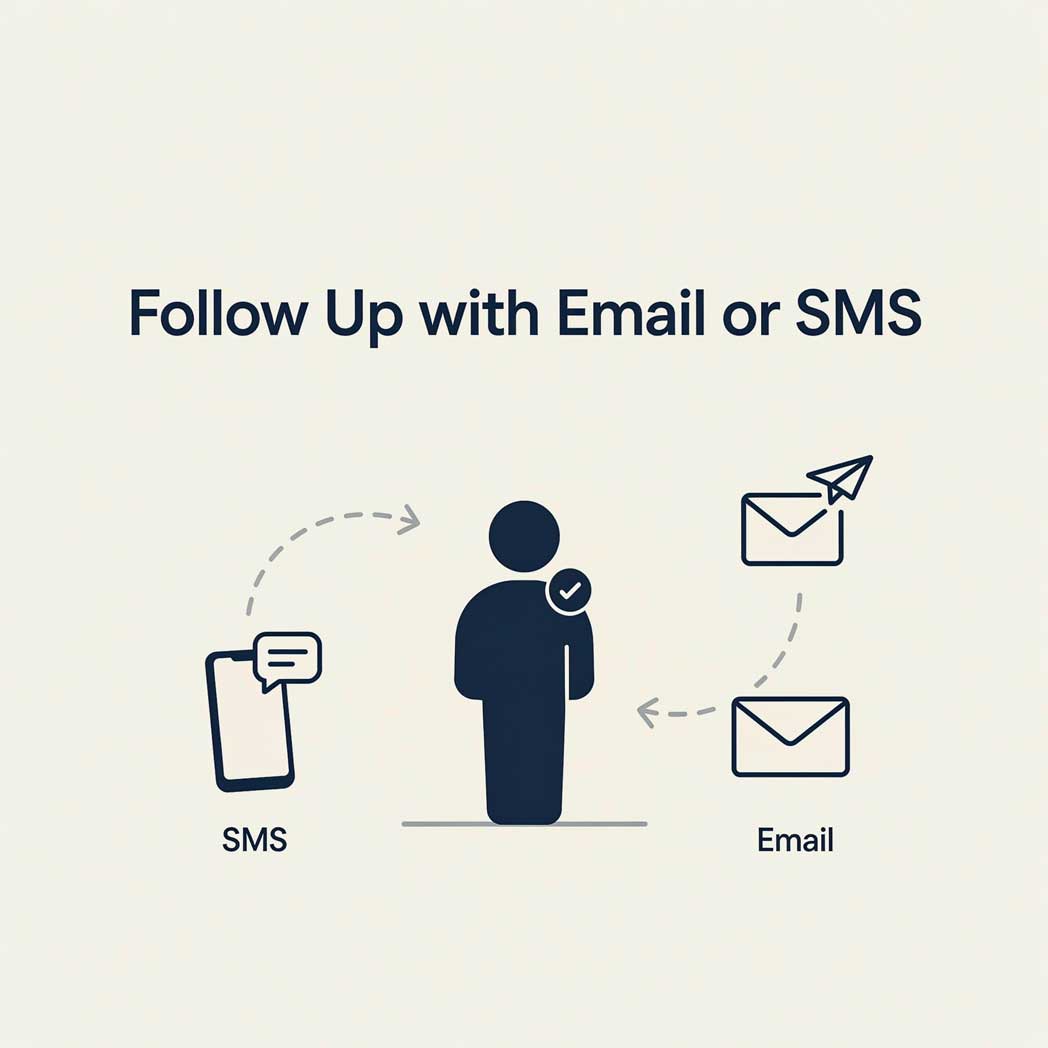
The practical default for a service business: SMS for anything time-sensitive, email for anything with detail, and a task for a human whenever the job is worth more than the cost of a call.
What the sequence should actually be
Here is a shape that fits how people actually hire trades. Adjust the details, but keep the proportions.
Immediately. Send an acknowledgment. Name your business, confirm what they asked for, say when a human will follow up. This one message does most of the work in the whole sequence.
Within the hour, a human. Not an automated message. A task, assigned to a named person, to call. For urgent work, make this minutes, not an hour.
Same day, if you made no contact. Try once more on a different channel. Filled a form and did not answer the phone? Text them. Called and you texted? Email them.
Next day. Send a short final message. Make it easy to re-engage, and just as easy to ignore. Something like "still happy to help if you need us, here is the number."
Then stop. This is the step everyone skips. If someone has not responded across three touches in two days, more messages will not fix that. They hired someone else, or the leak stopped, or the timing changed. Keep messaging past that point, and you become the company somebody blocks.
A longer sequence does have a real place, just a narrower one: quoted work with a genuine deliberation period. A roof replacement. A full system replacement. A remodel. Someone weighing a $22,000 job over three weeks is a different situation, and useful, periodic follow-up fits there. The mistake is applying that same pattern to a simple repair call.
One rule covers both cases. Any reply stops the automation immediately. Nothing damages trust faster than a customer talking to a human, while your system keeps firing scheduled messages as if the conversation never happened.
Tasks are the part that fails
Email and SMS steps almost always work, because software reliably does what it is told. Task steps are where sequences quietly break, because those depend on people.
A workflow that creates "call this lead" tasks faster than your team can work them does not produce more calls. It produces a queue everyone learns to ignore. And once a task list gets ignored, it stays ignored. Three high-priority call tasks a day that always get done beat forty that never do.
- Assign to a person, not a pool. A task that belongs to everyone belongs to nobody.
- Attach the context. What they asked for, what was already sent, which channel they came in on. A task that needs research first just gets postponed.
- Cap the volume. Match the daily task count to what your team can genuinely clear. Let the rest stay in automated follow-up.
- Escalate uncompleted tasks. An untouched call task on a high-value lead should reach somebody by end of day, not sit forever.
Guardrails and failure recovery
- A reply stops everything. The single most important rule in this build. Any inbound response pauses every scheduled message for that person.
- Suppress across sequences. Someone with an active job should not get new-lead nurture. Someone who complained should not get a review request. Your sequences need to know about each other.
- Honor opt-outs immediately, in any form. That includes "stop texting me" typed as a plain sentence, not just the magic keyword.
- Respect the clock. No automated texts late at night. A 2am message about a quote costs you the customer.
- Cap frequency hard. One message per channel, per day, maximum. Fewer is usually better.
- Alert on silence. Watch for missing sends. A sequence that quietly stopped firing looks exactly like a slow month.
- Watch credits and quotas. SMS runs on prepaid balances that run out, usually during your busiest week.
Wider failure patterns are covered in top AI automation bottlenecks in service businesses.
Measuring it without fake metrics
Since open rates are not real, measure things that are:
- Replies. A response is a clear signal that a human read the message, and it worked. This is the metric to chase.
- Contact rate. What share of leads end up in a real, two-way conversation with a person. That is the whole point of the sequence.
- Time to human contact. Not time to first automated message, which is trivially fast and proves nothing at all.
- Booked work. The only number that actually pays anyone.
- Opt-outs and complaints. Your early warning that the sequence runs too long or too often. Rising opt-outs mean stop sooner, not send more.
You will find claimed conversion lifts of 30 to 50% attached to sequences like this one. Those figures are not sourced anywhere real, and they cannot be. The gain depends entirely on what you do right now. If leads sit until Monday today, an instant acknowledgment plus a same-day call will change your business. If you already answer everything within the hour, a sequence adds very little on top.
Common questions
How many follow-up messages should a service business send?
For most local service work: an instant acknowledgment, a human call within the hour, one more try on a different channel the same day, a short final message the next day, then stop. Three touches across two days. If they haven't responded by then, more messages won't fix it.
Should I use SMS or email for follow-up?
Pick on the practical differences, not the open-rate stats, which aren't real measurements. SMS lands on a lock screen, so save it for anything time-sensitive. Email carries detail like quotes, photos, and financing well. And a task for a human call whenever the job is worth more than the cost of one.
When does a longer nurture sequence make sense?
For quoted work with a genuine deliberation period, like a roof replacement or a full system swap, where someone weighs a big decision over weeks. Useful, periodic follow-up fits there. The mistake is running that same pattern at a simple repair call that gets decided in a day or two.
What's the most important rule in the whole build?
Any reply stops the automation immediately. Nothing damages trust faster than a customer talking to a human while your system keeps firing scheduled messages as if the conversation never happened. Honor opt-outs in any form, respect the clock on late-night texts, and cap frequency at one message per channel per day.
Does your homepage pass the three second test?
A visitor decides in about three seconds whether your site is for them. Put your address in and I will send you what a stranger actually takes from it, and the specific things to fix.
Scan my site free →Following up inconsistently when you get busy?
I build short, front-loaded follow-up sequences for service businesses across Northeast Florida, sized to what your team can actually keep up with.

Mike is the founder of gravityGone, where he helps small businesses in Northeast Florida grow through Web Development, SEO, and Marketing Automation.